

New stars are forming...
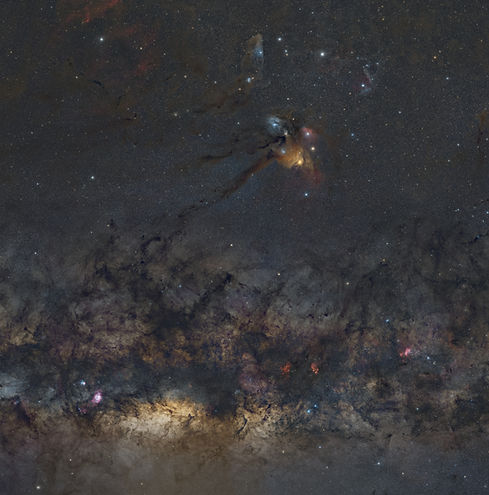
The Rho Ophiuchi Cloud is one of the closest to Earth and most extensively studied star-forming regions in our Milky Way. It lies about 460 light-years from Earth in the constellation Ophiuchus and consists of vast clouds of gas and cosmic dust. Within these dense clouds of matter, individual regions collapse under their own gravity, giving rise to new stars and, later, planetary systems.
The Rho Ophiuchi Cloud is considered a natural laboratory for studying star and planet formation. Because of its relatively close proximity, scientists can study the early stages of star development in great detail, thereby gaining important insights into the formation of solar systems. For this reason, this region is one of the most important observational targets in modern astronomy.
Taken by Moritz Mayer with the SV545 telescope and a Touptek SkyEye 24AC camera at the Kuzikus Wildlife Research & Astrofarm in Namibia.
A mosaic of 42 individual images with a total exposure time of approximately 12 hours.
Here is the link to Moritz Mayer’s profile on Astrobin:
Messier 51—the cosmic whirlpool...
The galaxy Messier 51, also known as the “Whirlpool Galaxy,” is one of the most famous spiral galaxies in the sky. It lies about 23 million light-years away in the constellation Canes Venatici and is a popular observation target for astronomers because its spiral structure is particularly easy to see.
Typical of such galaxies are their curved arms, which contain a great deal of gas and dust. It is precisely there that new stars are constantly forming. Another striking feature of Messier 51 is that it is not alone: it interacts with its smaller neighboring galaxy, NGC 5195. Their mutual gravitational pull shifts streams of material, which further stimulates star formation.
Messier 51 is particularly exciting for beginners because it’s a good example of how galaxies are structured and how they can influence one another—in other words, it’s not a static system, but one that’s constantly changing.
Taken with the Svbony 122mm APO (f/5.6) and the SV605CC camera. Exposure time: just under 7.5 hours.

IC1805 & IC1848—one heart and one soul...
The Heart and Soul Nebulae are among the most impressive star-forming regions in our Milky Way and are located in the constellation Cassiopeia, about 7,500 light-years away. They consist of massive clouds of hydrogen gas and dust that glow in reddish hues. This glow is caused by high-energy radiation from young stars ionizing the hydrogen—a typical process in so-called emission nebulae.
New stars are continuously forming within the nebulae: denser regions of gas collapse under their own gravity until nuclear fusion finally begins. In the Heart Nebula in particular, strong stellar winds and UV radiation from a young star cluster shape the striking, curved structures.
Taken with the Svbony SV545 wide-field telescope and the SC571CC camera. Exposure time: 2 hours 45 minutes

Messier 1 - the Crab Nebula
The supernova remnant Messier 1, also known as the Crab Nebula, is one of the most famous objects in the sky. It is located in the constellation Taurus and was formed by a massive stellar explosion observed by Chinese and Arab astronomers in 1054. During this supernova event, a massive star was destroyed, ejecting its outer layers into space.
At the center of the nebula lies a rapidly rotating neutron star known as the Crab Pulsar. It emits intense radiation and drives the nebula’s expansion. The Crab Nebula continues to expand at high speed to this day and emits light across various wavelength ranges, from radio waves to X-rays.
Messier 1 was discovered in 1731 by John Bevis and later included in Charles Messier’s famous catalog. Today, it serves as an important research object in astronomy.
Imaged with the Svbony SV550 122mm APO telescope and the SV605CC camera. Exposure time: just under 14 hours

The Sun—Our Home Star
The Sun is the central star of our solar system and the most important source of energy for life on Earth. It formed about 4.6 billion years ago from a massive cloud of gas and dust. Inside the Sun, hydrogen atoms fuse into helium through nuclear fusion, releasing enormous amounts of energy.
The Sun consists mainly of the elements hydrogen and helium and has a surface temperature of around 5,500 degrees Celsius. Its energy reaches Earth in the form of light and heat, enabling plant growth and sustaining our planet’s climate.
The Sun’s outer layer, known as the corona, is visible during solar eclipses. In addition, the Sun exhibits activity in the form of sunspots and eruptions, which can influence what is known as space weather. For astronomy, it is an important reference star, as it is the only star that can be studied in detail.
Captured with the Svbony SV550 80mm APO telescope and the SV605CC camera.

Bode’s Galaxy and the Cigar Galaxy
The galaxy duo M81 (“Bode’s Galaxy”) and M82 (“Cigar Galaxy”) in the constellation Ursa Major is one of the most spectacular sights in the northern sky and impressively demonstrates how galaxies can influence one another. The magnificent spiral galaxy M81, also known as Bode’s Galaxy, embodies the classic elegance of an “island universe” with its wide-spreading, almost perfectly symmetrical arms. Hidden within its brightly glowing center is a massive black hole that governs the dynamics of this majestic structure.
In stark contrast to this is its direct companion, M82, known as the Cigar Galaxy due to its elongated and disheveled shape. This galaxy is a place of extreme instability and activity: a close encounter between the two objects hundreds of millions of years ago literally shook M82 with enormous tidal forces. This gravitational influence triggered an explosive burst of star formation, known as a starburst. Today, as a result of this turbulence, M82 is hurling enormous amounts of hot gas far out into intergalactic space, while M81 continues to stand as a stable, luminous example of a spiral galaxy in the heavens.
Taken with the Svbony SV550 122mm APO telescope and the SV605CC camera. Exposure time: just under 13 hours
